Home › Concrete Sidewalk and Walkway
We install safe, durable concrete sidewalks and walkways for homes in Leesburg, VA. Our team grades for proper drainage, sets clean forms, and finishes surfaces that are easy to walk on. Whether you need a front entry walk, garden path, or connections to your driveway and patio, we pour concrete paths that last.
Leesburg Concrete Company provides professional concrete sidewalk throughout Leesburg, VA, Virginia and the surrounding area. Our licensed, insured crew delivers safe, clean, on-time work with a free estimate before anything begins. Call (571) 601-2614 or request your free quote.
Concrete Sidewalks Built for Leesburg’s Weather and Foot Traffic
Leesburg Concrete Company installs concrete sidewalks and walkways that are sized, reinforced, and drained for the way people actually use them in Leesburg, VA. Our work is not just about pouring a strip of concrete. We look at slope, soil, tree locations, and how the sidewalk connects to driveways, porches, and town walkways so it holds up and stays safe.
Leesburg sees freeze–thaw cycles, clay-heavy soils, and plenty of tree roots. A sidewalk that might last 5 years in another climate can start lifting or cracking here in 2 if it is not designed correctly. We account for this with proper base prep, control joint layout, and, when needed, thicker sections or reinforcement.
When you call Leesburg Concrete Company, we start by asking how the walkway will be used. A narrow garden path that only sees light foot traffic might be 3 feet wide, while a sidewalk that connects a front door to the street or a neighborhood trail typically needs 4 feet or more. For wheelchair access or strollers, we recommend at least 4 feet clear width, gentle slopes, and smooth broom finishes for traction.
We work everywhere in and around Leesburg, from older town neighborhoods with tight property lines to newer communities with HOA guidelines. We understand local permitting requirements and typical setbacks so your concrete sidewalk does not cause issues later with the county or an HOA review.
How We Install a Concrete Sidewalk or Walkway in Leesburg
Our installation process is consistent on every concrete sidewalk project so the finish and durability are predictable.
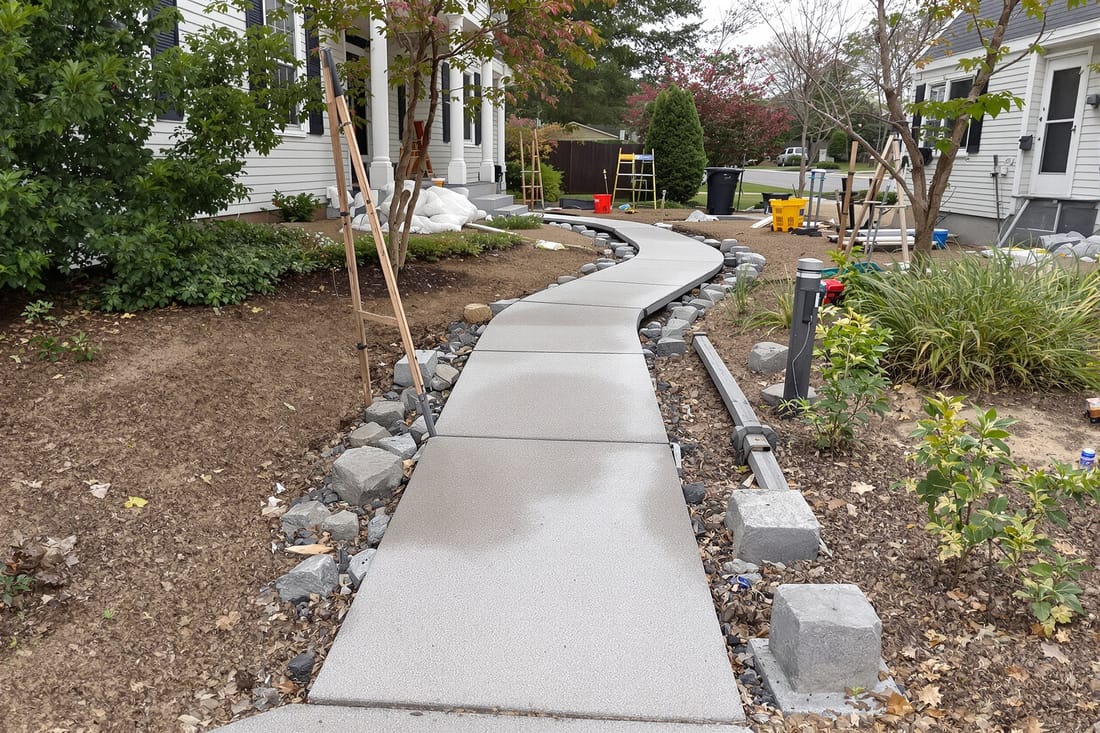
1. Layout and marking: We mark the exact path and width of the sidewalk with paint and stakes, checking property lines and any existing utilities. For front walkways that tie into town sidewalks, we verify elevation so there is no trip at the connection.
2. Excavation and subgrade: We remove grass, old concrete, and soft soil to reach a stable base. In most Leesburg yards this means 6 to 8 inches below the finished surface. If we hit very loose or wet clay, we dig a little deeper and replace it with compacted aggregate so the sidewalk does not settle later.
3. Base stone and compaction: We install a layer of crushed stone or gravel, usually 3 to 4 inches thick, then compact it with a plate tamper. A properly compacted base is what stops corners from dropping and slabs from rocking.
4. Forms and slope: We build wood or metal forms to shape the sidewalk, then set the slope so water runs away from your home and does not pond in the middle. Typical sidewalk thickness is 4 inches, but we might increase to 5 or 6 inches in high traffic or heavy loading areas, such as near driveways.
5. Reinforcement and joints: For most residential sidewalks we use control joints every 4 to 6 feet, either hand-tooled or saw-cut. On longer or wider sidewalks that may see heavier use, we often add wire mesh or rebar to limit crack movement. Control joints do not prevent cracks, they tell the concrete where to crack so it looks neat.
6. Pouring and finishing: We pour the concrete, consolidate it to remove air pockets, then level it. Most homeowners choose a light broom finish that provides traction in rain and snow. Edges are rounded to reduce chipping. Decorative areas can receive a smoother finish, stamped texture, or colored concrete, depending on how slick you are comfortable with.
7. Curing and cleanup: We apply curing methods that fit the weather, such as curing compound or covering when needed. Proper curing makes a bigger difference than most people realize in long term strength. Then we remove forms, backfill along the edges, and clean up the site.
Material and Design Options for Your Concrete Sidewalk
A basic concrete sidewalk in Leesburg typically uses a 3,500 to 4,000 PSI concrete mix with air entrainment, which helps the slab handle our winter freeze cycles. For drive lane crossings or commercial use we may specify a higher PSI mix. Leesburg Concrete Company orders mixes from local plants and adjusts based on placement temperature and weather.
For most homes, a standard gray broom finish is the best value. It is inexpensive, strong, and offers good slip resistance. If you want more visual impact or you are trying to match a higher end entry, there are several upgrades:
• Colored concrete: Integral color is mixed into the concrete at the plant, giving you a uniform tan, charcoal, or other tone throughout the slab. Color hardener, which is applied at the surface, creates stronger color but is more labor intensive.
• Stamped concrete: We can imprint the surface to mimic stone, brick, or slate. This is useful when you want the look of pavers but want fewer joints that weeds can grow through. Stamped walkways require careful sealing and periodic resealing.
• Exposed aggregate: The top layer of paste is washed off to reveal the stone in the concrete. This gives a textured, decorative look with very good traction. It is popular around backyard patios leading to pools.
We also pay attention to details like expansion joints at connections with your porch or garage, thicker edges where a sidewalk meets a driveway, and how your plants and mulch beds interact with the new walkway. Our goal is a sidewalk that looks intentional, not something added as an afterthought.
Lighting conduits, drainage pipe crossings, or future irrigation lines can be installed under the sidewalk during our work so you do not have to cut the slab later. If you plan to add low-voltage path lighting or a front yard drainage improvement, it is cost effective to coordinate that at the same time.
Costs, What Drives the Price, and How to Control It
Concrete sidewalk pricing in Leesburg, VA is driven by more than just square footage. When Leesburg Concrete Company prepares an estimate, we factor in site access, existing conditions, and the design you choose.
Key cost drivers include:
• Demolition and removal: Tearing out old cracked concrete, brick, or pavers and hauling them off is often a bigger part of the cost than people expect. If access requires wheelbarrows instead of machinery, labor time increases.
• Thickness and reinforcement: A standard 4 inch residential sidewalk with basic joints costs less than a 5 or 6 inch thick walkway with rebar or heavy mesh. Areas that must carry vehicles or equipment need more structure.
• Shape and layout: Straight runs are faster and cheaper than curved, winding paths. Tight radiuses, complex garden routes, and multiple steps or landings require more forming and labor.
• Finish type: Basic broom finish is the most economical. Color, stamping, exposed aggregate, borders, and inlays all add time and materials.
• Drainage and base work: Problem soils, steep slopes, or water that currently drains toward your house may require extra excavation, stone, or small retaining edges. Fixing these issues during sidewalk installation avoids future settlement or water problems, but it does affect the price.
If you want to keep costs under control, decide what is non-negotiable and where you are flexible. For instance, keeping a simple shape and standard gray concrete while investing in a slightly wider walkway often gives the best mix of comfort and value. We can price a base option and one or two upgrade options so you see the difference clearly.
Our written estimates itemize the major components so you understand exactly what you are paying for and what is included, such as demolition, base stone, thickness, and finish type.
Common Sidewalk Problems in Leesburg and How We Prevent Them
We see the same patterns of sidewalk damage around Leesburg, and we design our work to avoid them.
Heaving from tree roots: Older neighborhoods with large oaks and maples often have sidewalks lifted several inches. When we replace these, we look at root locations and, if needed, adjust the alignment, add root barriers, or increase jointing so individual sections can move a bit without creating a big trip hazard. We also try to avoid cutting major structural roots that could harm the tree.
Cracking and settlement: Some hairline cracking is normal in any concrete, but wide, uneven cracks and sunken corners usually come from poor base prep or missing joints. Our focus on proper compaction, correct joint spacing, and, when needed, reinforcement, reduces this risk. In problem clay soils we may suggest a thicker base or geotextile fabric between soil and stone.
Water pooling and icing: A sidewalk that holds water will become a sheet of ice in winter. We set slopes so water drains off to grass or landscaping instead of back toward foundations or sidewalks. In cases where grades are tricky, we may add small drains or adjust heights at entries.
Surface scaling and salt damage: In Northern Virginia, de-icing salts and repeated freezing cycles can roughen and pit poor quality concrete. We use air-entrained mixes suited for our climate and recommend less aggressive de-icers, such as calcium chloride instead of rock salt, especially in the first winter. Proper curing also plays a role in resisting surface damage.
Trip hazards at transitions: Where your new sidewalk meets existing town walks, steps, or driveway slabs, we carefully match height and slope. If an older slab is already out of level, we can discuss whether to replace it at the same time or create a smoother transition that does not violate safety guidelines.
When to Schedule and What to Expect From Leesburg Concrete Company
In Leesburg, the best time to install concrete sidewalks is typically from April through early November, when temperatures stay above freezing at night and below roughly 90 degrees during the day. We do work outside that window at times, but it can require additional measures such as blankets or accelerators, which can affect cost. For most homeowners, spring and fall are ideal because curing conditions are milder.
Once you approve the estimate, we schedule a start date and let you know how long the work will take. A straightforward residential concrete sidewalk often takes one to two days for removal, prep, and pour, plus several days of curing time before you should use it. Foot traffic is usually allowed after 24 to 48 hours, but we recommend 7 days before placing heavy items or using equipment near the edges.
Before we arrive, we ask you to mark any private utilities such as landscape lighting or irrigation if you know their locations. Public utilities are located through the standard ticket system. We also clarify access points, parking, and where materials and equipment can be staged.
During the job, you will see our crew excavating, compacting the base, installing forms and reinforcement, pouring concrete, and finishing the surface. We keep the work area as tidy as the job allows and communicate if weather affects the schedule. After the pour, we place caution tape or barriers to keep pets and people off the fresh concrete.
Leesburg Concrete Company is based in the local area, so we are familiar with Leesburg’s soil conditions, typical subdivision layouts, and county inspection requirements. When the project is finished, we provide basic care instructions for your new concrete sidewalk, including when to seal decorative finishes and what de-icing products to avoid in the first winter.